Pacific Knotworks is a Hawai’i-based craft and educational enterprise exploring the art, history, ingenuity, and connections found in rope work throughout the Pacific.
But Pacific Knotworks is about more than knots,
It’s about connections.
Connections between people and the ocean.
Between materials and the places they come from.
Between practical skills and artistic expression.
Between generations.
And between cultures that, for centuries, crossed an enormous ocean
and found ways to thrive on islands scattered across it.
Journeyman Polymaths
We sometimes describe ourselves as “at best, journeyman polymaths.”
We are no longer beginning students, but we are far from being masters.
A journeyman knows enough to work with his hands, solve problems, recognize good work, and understand that there is still much to learn.
A polymath is curious enough to look beyond a single discipline—to notice connections between things that might initially seem unrelated.
That combination describes much of what we love about Pacific Knotworks.
We are fascinated by knots and ropework,
but that curiosity quickly leads somewhere:
A particular fiber leads us to a particular island.
A lashing leads us to a particular canoe.
A voyaging canoe leads us to rediscovered ancient navigation.
New ways of navigation lead us to new paths of migration.
Migration leads us to language, culture, history, and the
extraordinary story of people who crossed an immense ocean
without modern instruments.
A knot that looks decorative often has a practical purpose.
A particular lashing may reveal something about the materials available on an island.
A rope-making technique may tell us something about the plants, environment, technology, and daily life of the people who developed it.
The connections are the fascinating part.
We learn from cultural practitioners, craftspeople, canoe builders, historians, museums, historical sources, and contemporary practitioners who are preserving and reviving traditional knowledge.
We practice with our own hands.
We ask questions.
We make things.
And whenever possible, we try to understand not only how something was done, but why people found a way to do it in the first place.
We may be journeymen.
But we are enthusiastic ones.
There is a very big Pacific out there, and we still have a lot to learn.
We are fascinated by knots and ropework,
but that curiosity quickly leads somewhere:
A particular fiber leads us to a particular island.
A lashing leads us to a particular canoe.
A voyaging canoe leads us to rediscovered ancient navigation.
New ways of navigation lead us to new paths of migration.
Migration leads us to language, culture, history, and the
extraordinary story of people who crossed an immense ocean
without modern instruments.
A knot that looks decorative often has a practical purpose.
A particular lashing may reveal something about the materials available on an island.
A rope-making technique may tell us something about the plants, environment, technology, and daily life of the people who developed it.
The connections are the fascinating part.
We learn from cultural practitioners, craftspeople, canoe builders, historians, museums, historical sources, and contemporary practitioners who are preserving and reviving traditional knowledge.
We practice with our own hands.
We ask questions.
We make things.
And whenever possible, we try to understand not only how something was done, but why people found a way to do it in the first place.
We may be journeymen.
But we are enthusiastic ones.
There is a very big Pacific out there, and we still have a lot to learn.
A journeyman knows enough to work with his hands, solve problems, recognize good work, and understand that there is still much to learn.
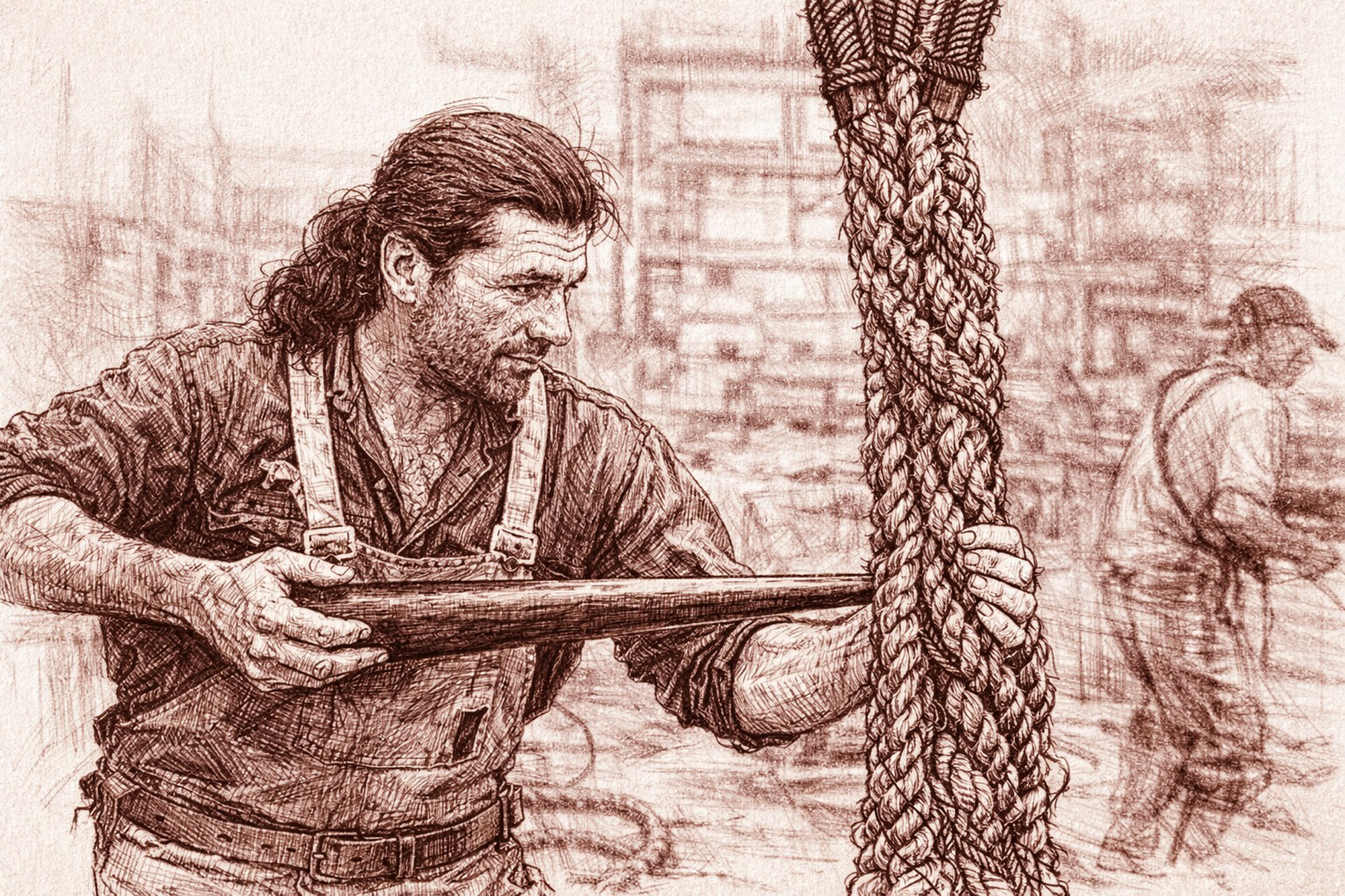
A polymath is curious enough to look beyond a single discipline
—to notice connections between things that might initially seem unrelated.
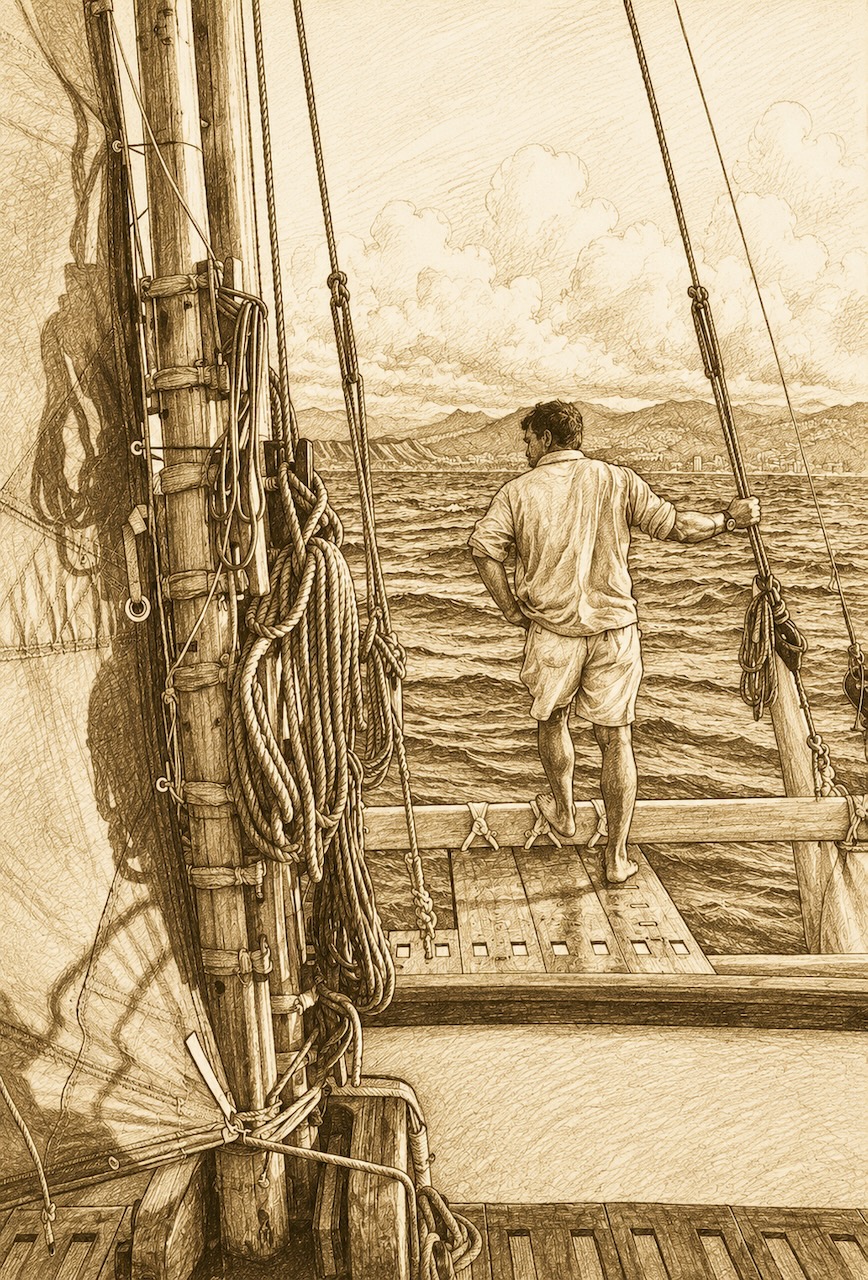

Cleats, shrouds and standing rigging aboard the reproduction 1779 Concord-class frigate L’Hermione, which achieved fame by ferrying the French General Lafayette to the United States in 1780, where he rejoined Washington’s troops and was instrumental in the Battle of Yorktown at the end of the American Revolutionary War.